
Disorder
Cats, Rabbis and Research Personas

Hello.
You are reading Understanding TikTok. My name is Marcus. I am in Italy. It is way too hot. My teenage nephew is wearing his black Joy Division T-Shirt in the blistering sun. Disorder, the opening track of their 1979 debut album Unknown Pleasures provides a perfect backdrop for recent videos on my FYP and current readings on slop.
I’ve been waiting for a guide to come and take me by the hand / Could these sensations make me feel the pleasures of a normal man?
What the heck is going on here? I mean what is really going on here? A new Cultural Commons special issue on brainrot, AI slop, and enshittification (European Journal of Cultural Studies) tries to map the terrain. Kendall and Markelj see a new phase of digital capitalism emerging in the wake of generative AI’s widespread integration into the foundations of platform culture where attention, data, and affect are relentlessly mined for value.
“Content is increasingly decoupled from communicative value and functions instead as a means of modulating attention at scale and optimising the emotions, moods, and atmospheres that flow through platforms”, argue Kendall and Markelj.
This of course does not mean that there is no communicative value. Quite the opposite. I found myself saving the”Faulenzergrüße” (Lazy greetings) to share them in the holiday group chat as a general AI absurdist comment on a lazy sunday spent lazing under stone pines while the entire news situation is dark but there are cats running around here – a hopefully shared short laugh as community-making effort.
But then I read Robert Topinka’s “Feed them slop: Alignment, attunement, and the affective lure of slopaganda and everything he wrote about the Trump Gaza video sounded somewhat true for the cat video too, despite its absurd, cute-grotesque:
Slopaganda doesn’t try to change what you believe—it goes after your attention, circulating through emotional resonance rather than persuasion. The point isn’t to impose order on chaos but to let “sticky” affects (Topinka, 2022) accumulate in the endless stream. To keep circulating, it must offer what Tony Sampson (2020, p. 12) calls an affective “lure,” hooking fickle attention in the platforms’ “feely milieu” and responding to the mood of the moment through whatever affordances are available. This is Thomas Rickert’s (2013) “ambient rhetoric”: persuasion relocated away from discrete exchanges between individuals and toward a continuous attunement to conditions, moods, and affordances. Slopaganda can therefore be obviously fake yet affectively real. What makes it work is not the credibility of any claim, but its alignment with those ambient conditions.
With that in mind I began to sense the potentially underlying “conditions, moods, and affordances”, the overdrawn nostalgia, traditional clothing, alpine folk music, the clean cat aesthetic. The ironic stance crumbled and sharing the video felt not only unfunny but potentially dangerous as I could no longer be sure this AI kitsch wasn’t ethno-nationalism repackaged as cat cuteness because I’d seen that same visual grammar (the tradition, the cleanliness, the alpine glow) replicated in endless ‘vibey’ Third Reich edits drifting through my feed.
Slopaganda disorders discourse while ordering affect: it dissolves coherent claims, stable speakers, and consistent meanings while still orienting audiences ideologically and leaving the gaps open for users to fill with their own meaning.
It’s getting faster, moving faster now, it’s getting out of hand
The Ukrainian start-up LetsData reported in July that AI-Generated Synthetic Personas Are Spreading Across Ukrainian Social Media. They have observed an operational shift in propaganda campaigns: “where influence operations once relied on one-off deepfakes, they now maintain a rotating cast of fabricated characters reused across publications and platforms. These personas are not meant to be realistic. Instead, their purpose is to reinforce narratives and create engagement.” Recurring synthetic personas include soldiers, MPs, military recruitment officers, veterans, and religious figures. Each one is not a one-off character but an archetype deployed again and again. People in the comment sections of this content frequently identify it as AI outright. They engage anyway.
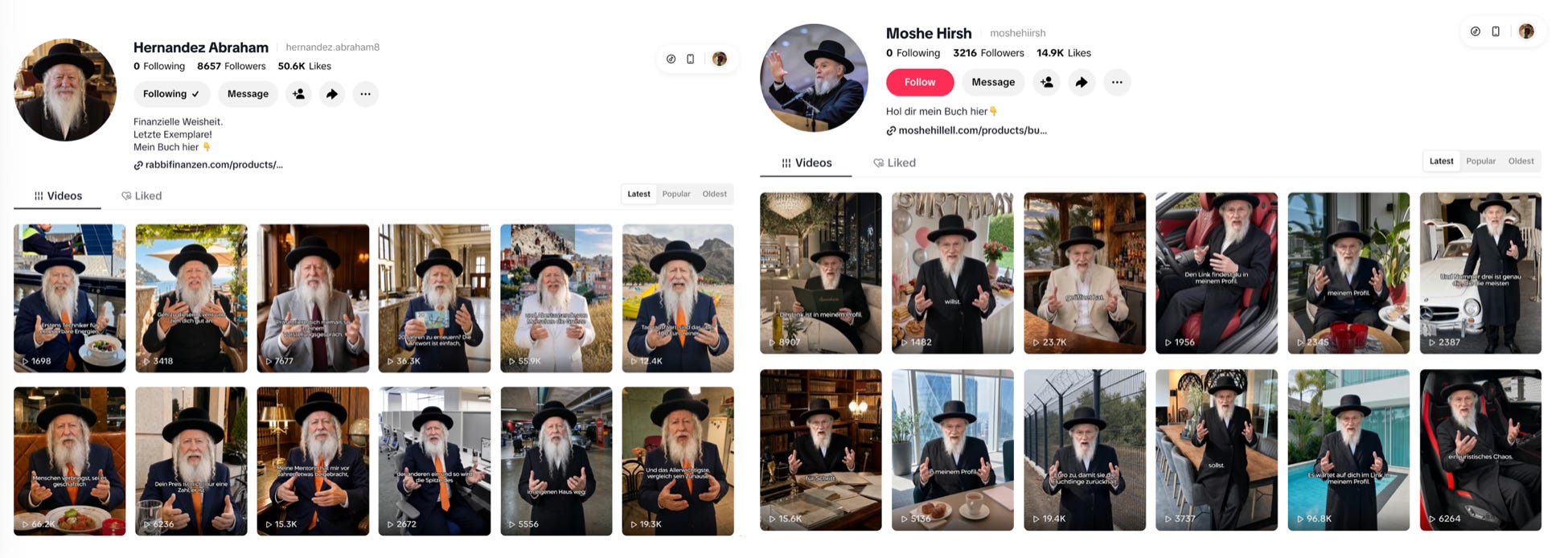
I observed the archetype “Jewish Rabbi” in the German-speaking parts of TikTok in recent days. Several accounts feature different AI-generated Rabbis who give financial advice and spread hot takes on various political and non-political topics, solidifying well-known antisemitic tropes. Interestingly, all accounts link to similar looking websites. Two near-identical sites “Rabino Empire” and “Rabbiner Finanzen” sell the same book, “Der jüdische Investment-Code,” each fronted by an AI-generated Orthodox rabbi against a city skyline, wrapped in the same fake countdown timers, the same “40–50% off,” the same implausible rating (”4.9/5 from over 1,000 millionaires”). Only the page count and author name change between them — the tell of a spun-up template with the fields swapped. What’s being sold is the stereotype itself: the premise that a secret Jewish code to wealth exists, the venerable bearded sage fused with piles of banknotes, the oldest canard about Jews and hidden money-power repackaged as a Shopify funnel. The naming of both the books and the users demonstrates a wicked bricolage with real world references (e.g. the operators appropriate a real rabbi’s name to lend false authority to their fake website) being woven into the fictional AI set-up.

“The Jewish AI Rabbi” at the same time serves as “old wise man” giving advice and as “greedy” stereotype – a perfect combination demonstrating that slopaganda is disordered rather than ordering. Unlike the ordering ambition of Bernays' classical propaganda — the promise, in the closing line of Propaganda (1928), to 'bring order out of chaos' — it coordinates affect without requiring coherent claims. Users can fill its images with their own meanings, but the range of available meanings is not politically neutral: the recurring archetypes, moods, and vernaculars still provide ideological orientation.
What means to you, what means to me
With AI systems as ideological attunement machines (Topinka) the account Preussenmoritz demonstrates how authentic users (tied to a real merch shop and a named movement – the pan-European far-right Identitäre Bewegung) deploy the slop grammar as strategy — running by hand the same affective attunement Topinka locates in the models. This time loaded with a performative authenticity that is built on vibes and vernaculars.
The video above (“POV: You just want to wash your hands, but your illegal migrants are dancing in the sink again”) is a racist version of a mixed AI-trend (“You go to the bathroom to wash your hands but your dog is genuinely dancing in the sink”) referencing other racist videos depicting “migrants” supposedly dancing and destroying cities with or without weapons. Supposed to be a “funny take” of a smiling protagonist entering the bathroom with a T-Shirt “Remigration” and the caption pomoting the shop where to buy this and other merch for the pan-European nationalist, ethno-nationalist, far-right ideological movement IB (Identitäre Bewegung / Identitarian Movement).
The platform vernaculars include captions (“cute date idea: 🇩🇪retten” as in save Germany), gestures ( the identitarian lambda (Λ) sign), reinterpreted or hijacked political slogans (“Bildet Banden” / Form Gangs; originally a historic feminist leftist slogan from the 1970s).
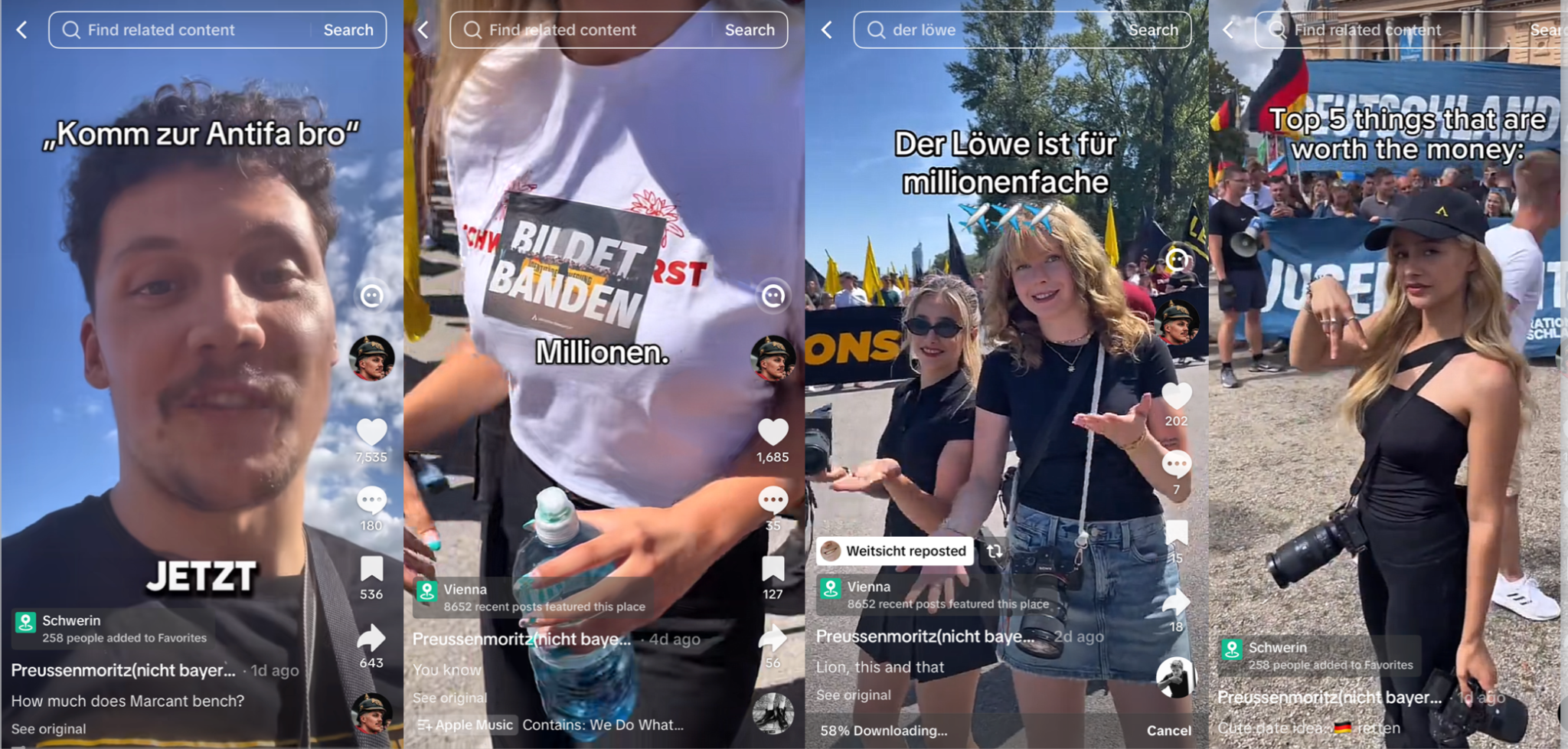
The effect is disordering again. Far-right and extremist positions arrive not as a set of political demands but as an audiovisual offering — an ostensibly cool assemblage of lifestyle, vibe, and codes with or without AI. It feels rather harmless. Just like cats.
Who is right, who can tell and who gives a damn right now?
Now what?
More Slop? In “From Slop to Slop On the Eerie Afterlives of (Generative) Images,” Gabriel Pereira dreams of “a little local slop factory, heating up my room as it churned out video after video, non-stop.” Constant Dullaart’s Patina Machine (2026) is exactly that: a closed-loop pipeline that writes, voices, and renders AI “video essays” about media theory and never stops — an automated system generating critical discourse about automation. Asked by Anika Meier for SLEEK whether this isn’t just his own version of flooding the zone with shit, Dullaart shrugs: “Yes, but it’s my shit.”
Research is needed to learn more about all variations of it. Elena Pilipets proposes a pretty precise methodology on how to do it in “Slopification, Mon Amour“: stop hating the algorithm and inhabit it instead. Rather than debunking slop or sorting it real-from-fake she builds a “sloppy research persona” who lurks, likes, and lets slop play on repeat, deliberately feeding her own feed until its patterns surface. What emerges isn’t a message but a riff: the repeated-but-varied phrase, familiar enough to stick, different enough to catch. In her example, a swarm of AI “military daddy” homecoming videos accumulates prayers and crying emojis across unrelated channels — not a coordinated campaign but ambient amplification, where the message matters less than its recurrence. It’s the same disorder I’ve been circling.
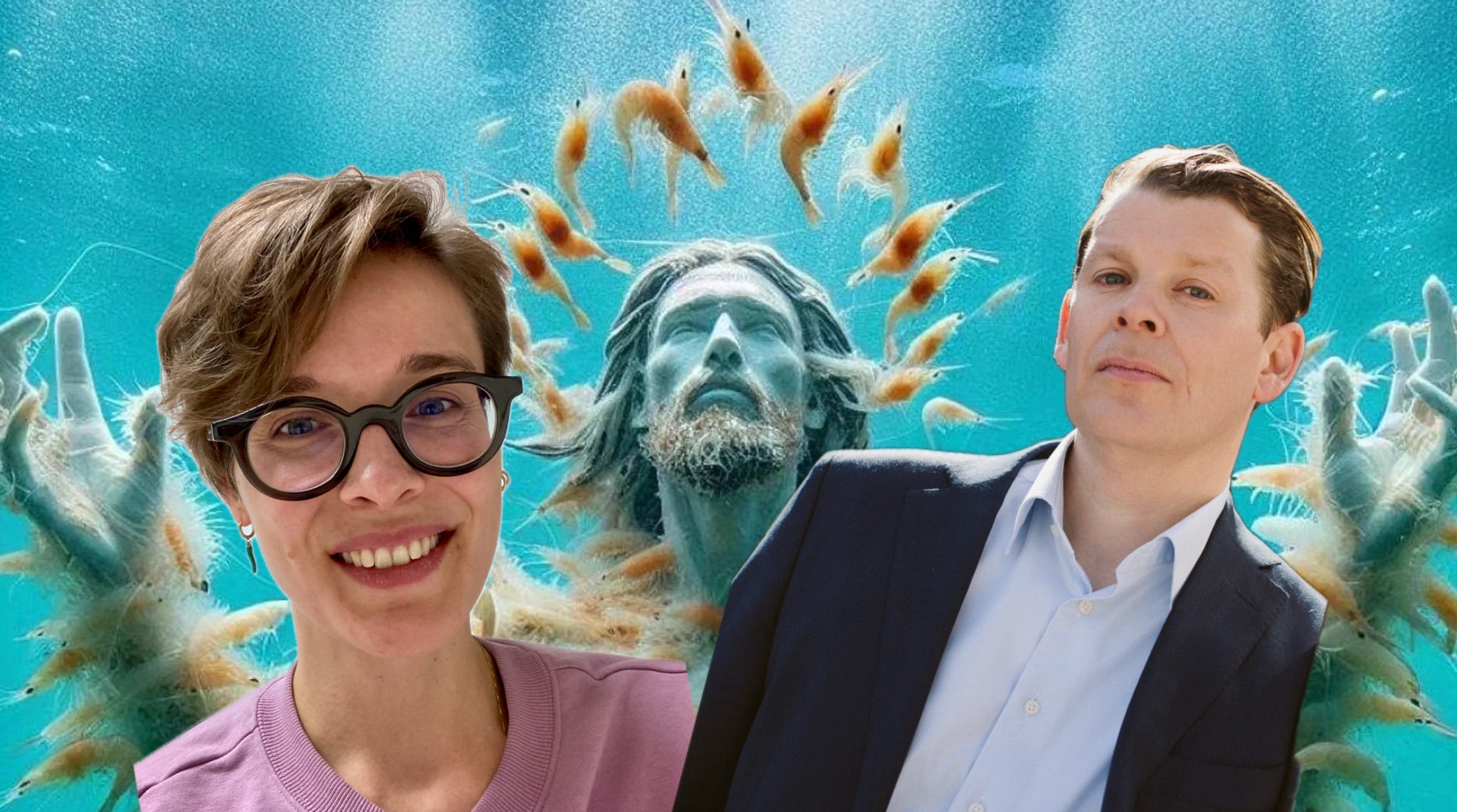
I’m therefore glad to say Elena and I will be working together in the coming months. At the forthcoming Autumn School, Synthetic Social Media: Studying Platform-Embedded AI at the University Siegen. And at this year’s Visual Communication Section Conference at the Institute of Media and Communication Studies, Klagenfurt where we will hold the opening keynote Slopmaxxing: Vibes, Memes, and the Aesthetics of Generative Co-Creation.
Feeling, feeling, feeling, feeling / Feeling, feeling, feeling
The comments section for this video reads something like this: Wth goin on😭, Where does this footage even come from, Are we fucking high?, This making me feel some typa way, Dude what, Woahhgg 👁️👄👁️, peak, holy fuck, how do I get there?, Very tuff…
The underlying sound is obviously a version of L’Amour Toujours, a song loaded on the platform since far-right crowds set racist lyrics to it. Yet it still remains somewhat open to users filling it with different meaning as there is for example a song like Alice by Bass Victim utilizing the sample in a totally different context. Perhaps this is what disorder sounds like: a politically contaminated sample that remains available for other attachments, never settling into a single meaning but never returning to “just music” either.
This piece is part four in what has become a little slop-series:
Part 1: Brainrot as Anti-Content
Establishes that slop/brainrot is an infrastructural condition, not a content problem — and that the disinformation frame (sender, message, deception, corrigible subject) can’t grip it.Part 2: Variations of Slop
Builds a working toolkit and locates slop’s operation across three scales — reception, production, and system — landing on “postdigital propaganda”: alignment produced inside the system, not by an actor.Part 3: Slopmaxxing
Turns the lens back on the analyst and catches the observer inside the loop — the pivot of the series. Establishes that detection is not refusal.Part 4: Disorder
Argues that slopaganda disorders discourse while ordering affect—coordinating ideological orientation without coherent claims—and that studying it means inhabiting the loop, where analysis and susceptibility become hard to tell apart.
Thanks for reading. If you’re interested in tailored insights, consulting, or policy support, get in touch. Here is Linkedin. Here is Bluesky. Ciao